Utility Billing
Oklahoma Solar Net Metering: Why Monthly Surplus Uses Avoided Cost
Sending electricity to the grid at noon does not by itself establish your net monthly surplus. Review the full billing period and the applicable purchase tariff.
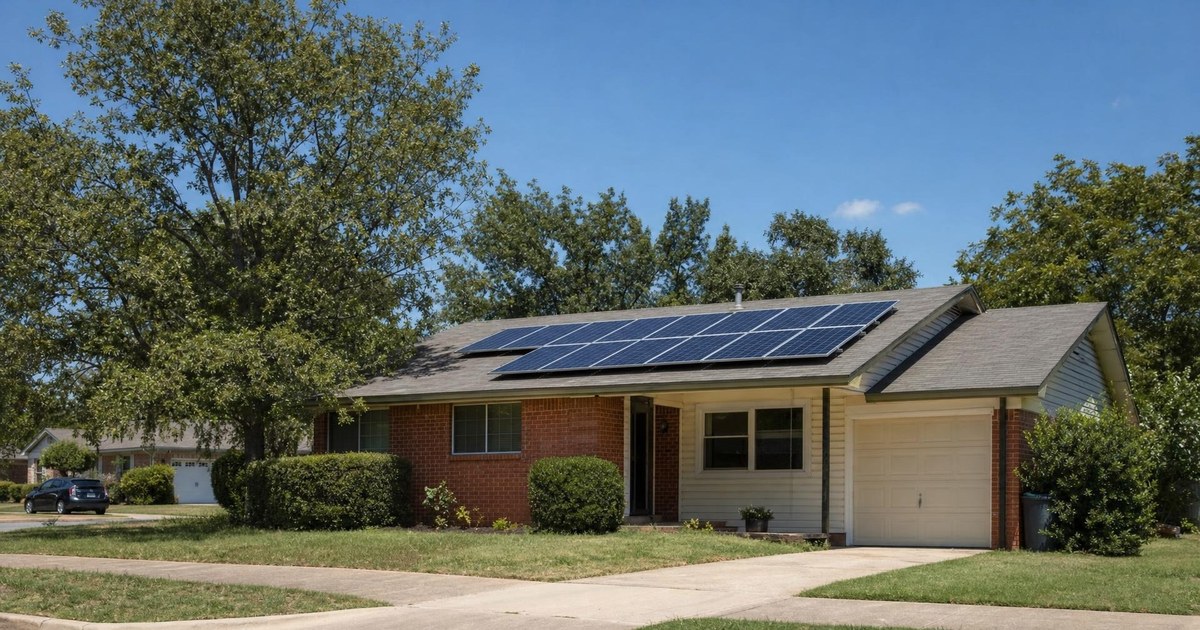
If you were told your Oklahoma utility would buy every extra solar kilowatt-hour at the same price it charges you, ask what “extra” meant in that calculation. The state's net-metering framework distinguishes electricity offset during the monthly billing period from net surplus left after that comparison.
This matters when the solar app shows exports but the utility credit seems smaller than expected. An export reading at one moment is not the same measurement as the month's net surplus. Start by identifying your approved billing arrangement and matching the measurement periods.
The monthly comparison changes the value
The Oklahoma Corporation Commission explains that netting offsets consumption at retail energy rates up to the amount used at the location during the billing period. Additional net production is purchased at the utility's avoided energy cost.
OAC 165:40-9-3 specifies the monthly meter-reading period and provides for surplus to be paid or credited in dollars in the following billing period or periods. The monthly charge or minimum bill remains applicable. This is not an unlimited retail-value bank that can simply be treated as cash equal to your usual purchase price.
For a hypothetical household, afternoon exports may be balanced by electricity bought later in the same billing period. A different household may finish the period with surplus. A savings model needs to show that distinction instead of assigning one compensation assumption to every exported unit.
Check eligibility without confusing power and energy
The current rule makes the option available to qualifying producers with rated capacity up to 300 kilowatts, compatible equipment and an executed purchase agreement. It also allows exclusion from net metering when installed capacity exceeds 125 percent of the customer's peak load, with compensation under a different applicable tariff.

That peak-load comparison is not a promise that producing 125 percent of annual household kilowatt-hours qualifies. If a proposal uses those concepts interchangeably, ask the utility to confirm the approved system capacity and billing option in writing. Leave design and electrical questions to qualified professionals.
Identify your utility's actual purchase schedule
The OCC framework covers the cooperative and investor-owned utility arrangements described in its rule. Do not assume the same tariff applies to a municipal account, or that two utilities calculate avoided energy cost identically. Your signed purchase agreement and current utility schedule are necessary parts of an account-level review.
OG&E's posted NEBO tariff illustrates the need for precision: it defines avoided energy cost using Southwest Power Pool market prices and specified time periods. That document is an example of a utility-specific calculation, not a statewide fixed export price. A current revision must be confirmed before using it to price a particular customer's bill.
Ask for a corrected forecast you can check
Request the original monthly production and usage assumptions, the named tariff and the expected surplus payment for each period. If the seller only supplied an annual savings figure, ask for the calculation behind it. Retain the original proposal alongside any corrected version.
Compare the estimate with bills using the same opening and closing dates. Note the applicable fixed charges, imported electricity, exported electricity and net-surplus adjustment. A calendar-month app report may need reconciliation with a utility cycle that starts midway through the month.
Bring those records to Solar Exit's billing review. If the dispute involves the sales promise, loan or lease, include those documents in a contract review. The objective is to identify the unsupported assumption and the relevant agreement, not to assume a tariff mismatch automatically voids a contract.
General consumer information, not legal, tax or electrical advice. No fixed long-term compensation or contract outcome is promised.
Sources Reviewed
- OCC net-metering overviewReviewed October 15, 2026Reverified October 15, 2026. OCC current-rules index lists Chapter 40 effective July 25, 2019; sections 165:40-9-2 and 9-3 read directly. OG&E current index links NEBO Seventh Revised Sheets 70.10-70.13, issued November 26, 2024, effective January 1, 2025, Order 745601 / PUD 2023-000087. Replaces broken historical 2022 source URL for the same methodology example. No numerical avoided-cost rate asserted; OG&E TOU and SPP method not generalized statewide.
- Chapter 40, Subchapter 9Reviewed October 15, 2026Reverified October 15, 2026. OCC current-rules index lists Chapter 40 effective July 25, 2019; sections 165:40-9-2 and 9-3 read directly. OG&E current index links NEBO Seventh Revised Sheets 70.10-70.13, issued November 26, 2024, effective January 1, 2025, Order 745601 / PUD 2023-000087. Replaces broken historical 2022 source URL for the same methodology example. No numerical avoided-cost rate asserted; OG&E TOU and SPP method not generalized statewide.
- OG&E NEBO tariff, effective January 1, 2025Reviewed October 15, 2026Reverified October 15, 2026. OCC current-rules index lists Chapter 40 effective July 25, 2019; sections 165:40-9-2 and 9-3 read directly. OG&E current index links NEBO Seventh Revised Sheets 70.10-70.13, issued November 26, 2024, effective January 1, 2025, Order 745601 / PUD 2023-000087. Replaces broken historical 2022 source URL for the same methodology example. No numerical avoided-cost rate asserted; OG&E TOU and SPP method not generalized statewide.